

General information only — not legal advice. Laws change and outcomes depend on your specific circumstances. For advice tailored to your situation, call Andrew Byrnes Law Group on (02) 6210 1075.
Traffic charges that put your licence at risk can affect work, family care, insurance, and even where you live. In the ACT, one allegation for drink-driving, drug-driving, dangerous driving, excessive speed, or too many demerit points can shift quickly from a fine to losing the right to drive. The main problem is that many drivers focus on the ticket and miss the licence consequences, which often carry longer practical damage than the fine itself. This guide sets out which ACT traffic charges are most serious, how suspension works, and what to do early if your licence is on the line.
Which ACT traffic charges can lead to licence suspension or disqualification?
Yes. In the ACT, PCA or DUI, drug-driving, dangerous driving, fail to stop after a crash, driving while suspended, and excess demerit points are the main triggers. Access Canberra and the ACT Magistrates Court can both become relevant, depending on the offence and stage of the matter.
The key distinction is whether the penalty is administrative, court-imposed, or both. A full ACT licence usually hits suspension risk at 12 demerit points in a 3-year period. Drink-driving starts at more than 0.05 BAC for full licence holders, while learner and provisional drivers are expected to be at 0.00. Drug-driving in the ACT follows a zero-tolerance model for tested illicit drugs including THC, methamphetamine, and cocaine.
Serious offences move well beyond points. Dangerous driving, driving under the influence, and failing to stop or assist after a crash can lead to criminal charges, substantial disqualification periods, and sometimes imprisonment. A common mistake is assuming only “major” crashes threaten a licence. In practice, a single high-range allegation or a poor traffic history can be enough to put your right to drive at immediate risk.
How is licence suspension different from licence disqualification in the ACT?
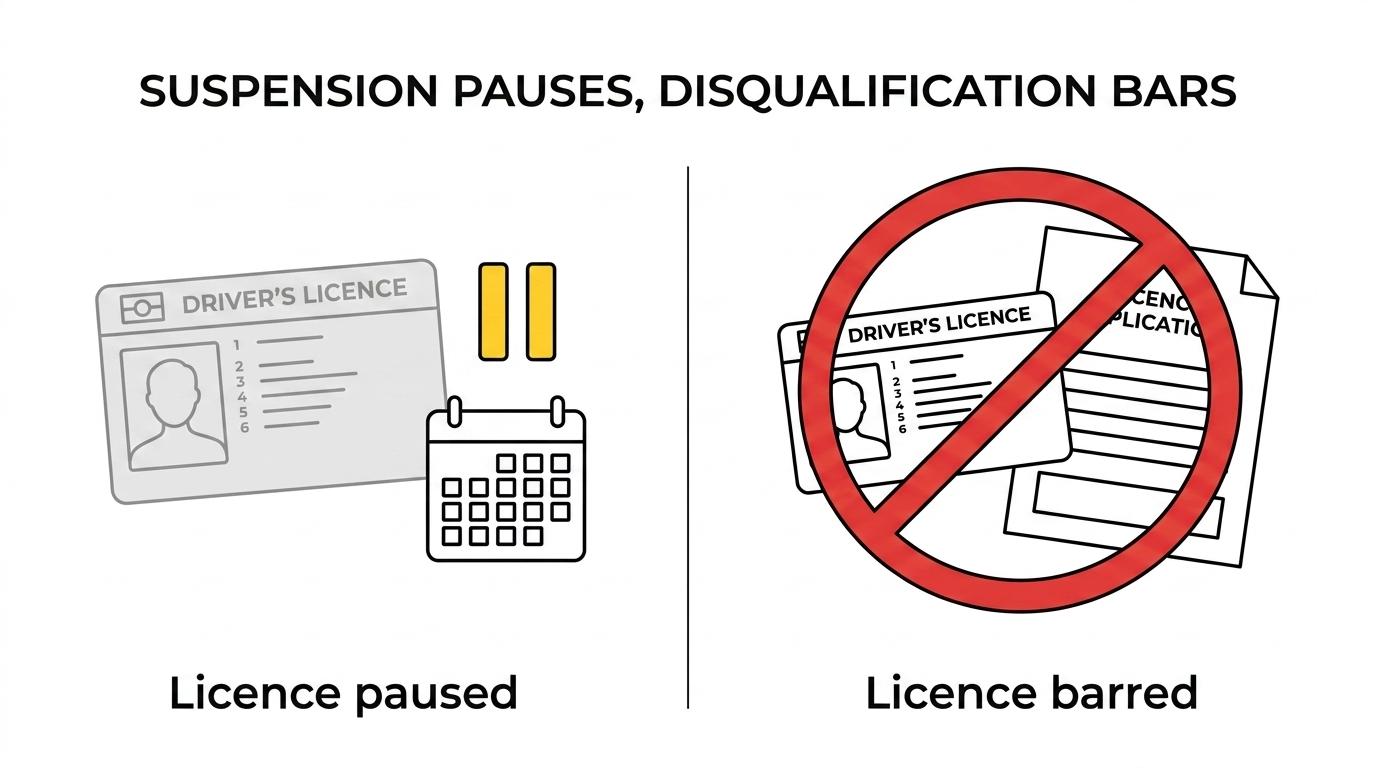
They are different. Access Canberra usually administers suspensions, while the ACT Magistrates Court imposes disqualifications after conviction. A suspension pauses your existing licence for a set period. A disqualification stops you from holding or getting a licence for that period.
Side-by-side comparison of ACT licence suspension and licence disqualification, showing who imposes each and how each affects a driver’s licence.
That difference matters because the pathways, deadlines, and practical outcomes can change. If your issue is demerit points, the suspension period is usually fixed by statute. If your issue is a court offence like PCA or dangerous driving, the court may have to impose a minimum disqualification, or it may have a broader sentencing discretion depending on the charge.
The trade-off is simple. Administrative suspensions can be rigid but sometimes easier to identify and plan around. Court disqualifications can carry heavier stigma and longer consequences, yet they also create room to contest the allegation, negotiate facts, or argue penalty. Many drivers use the terms interchangeably. That can be costly, because if you treat a disqualification like a standard points suspension, you may miss the right strategy.
What ACT legal support options are available when traffic charges risk your licence?
Several options exist. In Canberra, private criminal defence firms, Legal Aid ACT, and duty lawyer services each fill different roles. The right choice depends on whether your matter is urgent, contested, or likely to involve mandatory disqualification.
If your matter involves possible suspension, the most useful support is usually the option that can assess the brief, identify procedural issues, and appear in court quickly. Day-of-court help can be valuable, but it is not always designed for detailed evidence review or early negotiations with police and prosecutors.
- Andrew Byrnes Law Group: ACT-focused criminal defence and traffic representation for matters involving drink-driving, drug-driving, dangerous driving, driving while suspended, and related litigation in Canberra and surrounding NSW regions.
- Legal Aid ACT: Eligibility-based help that can be important if you qualify financially or need limited early guidance.
- Duty lawyer services at court: Useful for urgent appearance-day assistance, though often less suited to detailed preparation in contested matters.
- Other private Canberra criminal firms: A practical option when you want ongoing representation, evidence review, and advice tailored to your driving history and risk profile.
What should you do in the first 24 hours after an ACT traffic charge?
Act fast. ACT Policing, Access Canberra, and the court system run on deadlines, not intentions. The first day should be used to protect evidence, confirm your licence status, and avoid making admissions that narrow your defence later.
Step 1 is to confirm exactly what you were charged with and whether your licence is already suspended. The wording matters. “Drug-driving”, “DUI”, “PCA”, “dangerous driving”, and “drive while suspended” each carry different risks. If you are unsure, check the paperwork, not your memory.
Step 2 is to preserve evidence. Save dashcam footage, phone location data, rideshare receipts, medical records, photographs of signage, and any names of witnesses. If the allegation turns on identity, timing, or actual driving, early evidence can change the whole case. If you wait a week, CCTV may be gone.
Step 3 is to get legal advice before entering a plea or writing to police. A common misconception is that a polite explanation sent immediately will help. Sometimes it does the opposite by locking in admissions before the brief is tested.
How do demerit points cause licence suspension in the ACT?
They do so automatically once the statutory limit is reached. Access Canberra uses a rolling 3-year period, and a full ACT licence reaches the threshold at 12 points. Suspension length then increases with the total points accrued.
For full ACT licence holders, the current framework commonly operates like this:
- 12 to 15 points: 3-month suspension
- 16 to 19 points: 4-month suspension
- 20 or more points: 5-month suspension
Learner and provisional licence holders have lower point limits, so relatively minor infringements can become licence-threatening much faster. The practical danger is accumulation. One speeding offence, one mobile phone offence, and one red-light offence can stack more quickly than many drivers expect. Pro tip: paying an infringement is often treated as accepting the offence, so check the points impact before you finalise it.
How do ACT licence-loss rules compare with NSW for drivers near Queanbeyan or Yass?
They differ in important ways. The ACT generally uses a 12-point full-licence threshold, while NSW commonly uses 13 points for most unrestricted drivers and 14 for some professional drivers. Access Canberra and Transport for NSW also run different administrative systems.
That matters if you live on one side of the border and drive daily on the other. If you hold an ACT licence and offend in NSW, interstate demerit exchange can still affect your ACT driving record. If you hold a NSW licence and your matter is heard in the ACT, the licence consequences may still follow you home through cross-border enforcement processes.
The trade-off is not that one system is “easier”. NSW may allow a slightly higher full-licence points buffer, yet it also has its own immediate suspension settings and stricter categories for some speed-related conduct. Drivers around Queanbeyan, Goulburn, Cooma, and Yass should not assume the law of their home address controls everything. The offence location, licence type, and offence category all matter.
How should you prepare for an ACT Magistrates Court traffic matter?
Prepare early. The ACT Magistrates Court gives the best results to drivers who arrive with a tested case theory, organised documents, and a realistic penalty strategy. Good preparation can change both liability arguments and sentencing outcomes.
Step 1 is to identify your lane. Are you contesting the charge, negotiating facts, or pleading guilty with mitigation? Each path needs different material. A contested hearing may need video, calibration issues, or witness evidence. A plea in mitigation needs character references, a traffic history, treatment evidence, and proof of work or caring needs.
Step 2 is to collect documents that match the legal issue. Hardship alone rarely removes a mandatory disqualification. That is a common misconception. Still, an employer letter, roster history, medical appointments, and evidence of rehabilitation can matter strongly where the court has discretion over sentence length or conviction recording.
Step 3 is to rehearse the practical questions. If the magistrate asks why the offence happened, what you have done since, and how you will avoid reoffending, you need precise answers. Vague regret is weaker than verified action.
Can you avoid losing your licence for drink-driving or drug-driving in the ACT?
Sometimes, yes. ACT police procedures, breath analysis rules, saliva testing, and the exact charge all shape the outcome. The ACT Magistrates Court may have limited discretion in some matters and more room in others, especially where proof, procedure, or the charged offence can be challenged.
For drink-driving, the legal starting point is clear: full licence holders are generally limited to 0.05 BAC, and learner or provisional drivers are held to 0.00. For roadside drug testing, the issue is usually the presence of a relevant illicit drug rather than visible impairment. That is why drivers are often surprised to be charged even when they say they felt fine.
If the testing procedure was flawed, the identity of the driver is uncertain, the timeline is unreliable, or the prosecution facts overstate the conduct, then the licence outcome may shift. If the evidence is strong and the offence carries a mandatory disqualification, then the strategy usually turns to minimising the period and preparing for any interlock, education, or re-licensing requirements. A clean record helps, but it does not cancel a mandatory minimum.
What happens if the charge is dangerous driving, fail to stop, or driving while suspended?
These are serious offences. ACT Policing and the ACT Magistrates Court treat dangerous driving, fail to stop after an accident, and driving while suspended as conduct that can justify criminal penalties well beyond a fine. Licence loss is often the starting point, not the end point.
Dangerous driving allegations usually focus on risk creation, not just speed. If the prosecution says the driving exposed others to significant danger, or caused injury, then jail becomes a real sentencing issue. Fail-to-stop cases are often aggravated by injury, panic, or later conduct. A common mistake is thinking returning later always fixes the problem. It may help, but it does not automatically erase the original offence.
Driving while suspended often looks simple on paper and serious in court. If the suspension was validly in force and the driver knew, or should have known, the risk rises sharply. Prior traffic history, earlier suspensions, and the reason for the original suspension all influence penalty. In repeat matters, courts can move quickly from leniency to deterrence.
How do you get your licence back after a suspension or disqualification in the ACT?
You regain it by completing every condition, then reapplying correctly. Access Canberra, court orders, and any interlock or education requirements must all match up. If one part is incomplete, your practical return to driving can be delayed even after the stated period ends.
Step 1 is to confirm the exact end date and every attached condition. Was it a demerit suspension, a court disqualification, or both? Do you need a course, an interlock, a medical clearance, or fresh application paperwork? If you guess, you risk driving unlawfully.
Step 2 is to complete the conditions before the end date where possible. Drivers often wait until the ban finishes and only then learn they needed a program certificate or device approval. That delay is avoidable.
Step 3 is to reapply through the proper channel and keep proof. If you also have interstate matters, unpaid fines, or a suspension in another jurisdiction, clear them early. Cross-border issues can slow re-licensing more than the original court date.
When should you get legal advice for an ACT traffic offence that risks your licence?
Get advice early. ACT Policing, Access Canberra, and the ACT Magistrates Court each create time-sensitive decisions. Early legal input matters most when there is immediate suspension, a court date, a prior record, or any real chance of mandatory disqualification.
The strongest time to get advice is usually before you finalise an infringement, enter a plea, or attend the first court date. Early review may identify whether the issue is evidence, procedure, sentence, or re-licensing strategy. It also helps separate cases where a guilty plea is sensible from cases worth contesting.
Urgent advice is especially sensible when any of these apply:
- Immediate suspension: You have already been told not to drive.
- Border issue: The offence happened in NSW but you hold an ACT licence, or the reverse.
- Serious allegation: DUI, drug-driving, dangerous driving, fail to stop, or driving while suspended.
- Livelihood risk: Work, caring duties, or medical transport depend on your licence.
- Prior history: Existing points, earlier suspensions, or a previous traffic conviction may increase the penalty.
A final practical point: the best defence plan is often built before the prosecution brief is complete, not after. Early advice can preserve options that disappear once a plea is entered or evidence is lost.
Date:
April 29, 2026
Author:
Asfandyar (Ash) Shaffi
/
Junior Partner





.jpg)
.jpg)
.jpg)
.jpg)